
Second malaria vaccine to win global approval is cheaper and easier to make
The World Health Organization has recommended a shot called R21 to prevent the disease in children.
By Miryam Naddaf
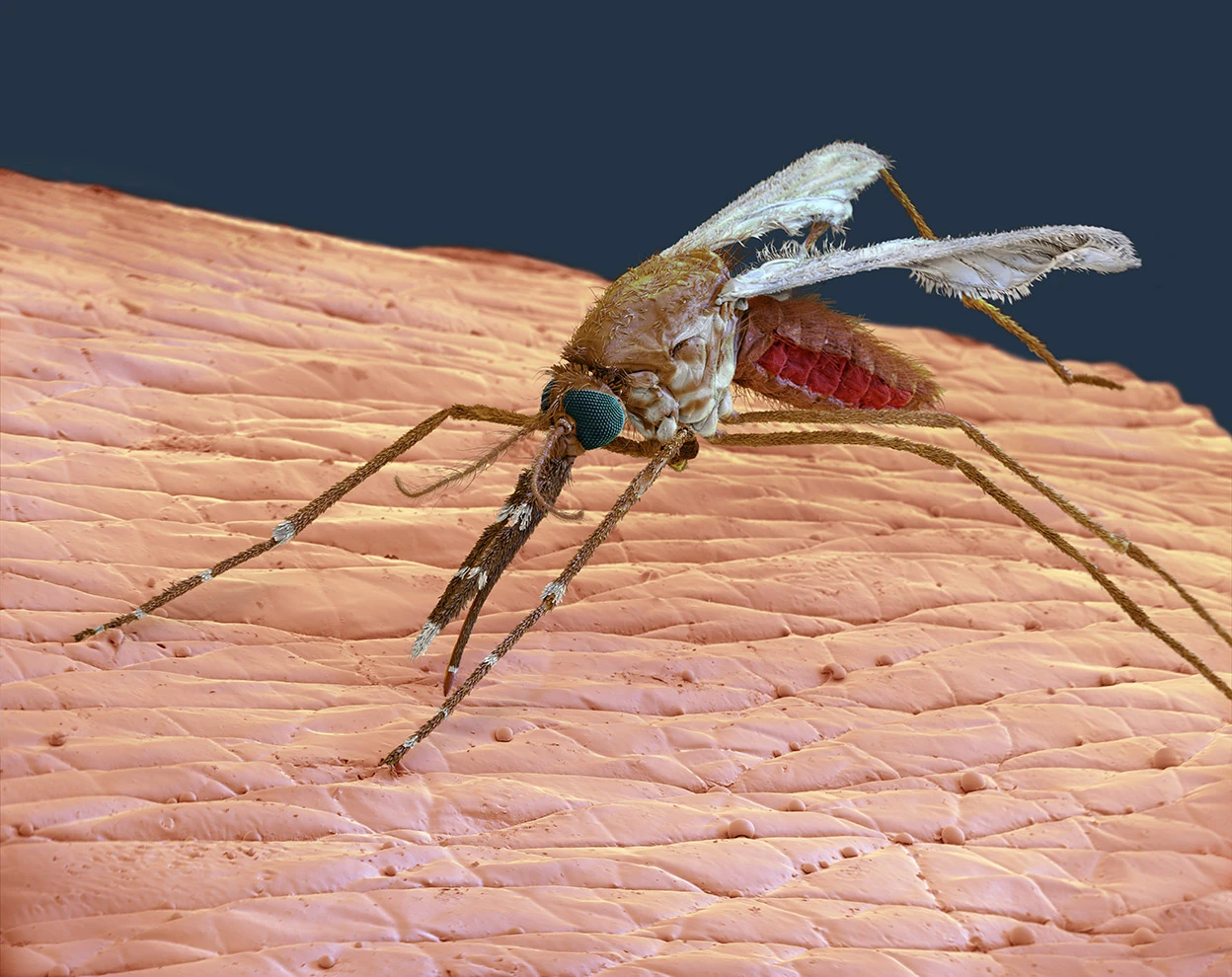
The Anopheles mosquito spreads malaria. Credit: Eye Of Science/Science Photo Library
The World Health Organization (WHO) has endorsed a second malaria vaccine to protect children against the deadly disease, which killed 619,000 people in 2021.
Researchers say that the vaccine, known as R21, is easier to make than the first-approved malaria vaccine, called RTS,S, and will be cheaper per dose.
“There’s going to be enough of it to actually give out to children,” says Jackie Cook, a malaria epidemiologist at the London School of Hygiene and Tropical Medicine.
R21 met the WHO’s target of 75% efficacy at preventing the disease in a trial with 4,800 children who each received three doses before a seasonal malaria peak. A booster dose after 12 months maintained protection. Data from the phase III trial, conducted in Burkina Faso, Kenya, Mali and Tanzania, were presented in a preprint1 posted on 26 September.
“By adding the vaccine to the current tools that are in place, tens of thousands of children’s lives will be saved every year,” said epidemiologist Mary Hamel — who leads the WHO’s malaria vaccine implementation programme — at a press conference in Geneva, Switzerland, on 2 October, announcing the endorsement. The WHO recommendation followed discussions by the agency’s Strategic Advisory Group of Experts on Immunization and its Malaria Policy Advisory Group last week.
Already approved in Burkina Faso, Ghana and Nigeria, the vaccine will be available in mid-2024 at US$2–4 per dose. RTS,S, which the WHO recommended for use in children in 2021, costs around $9.80 per dose.
More supply
RTS,S, which is sold under the name of Mosquirix and produced by GSK, a pharmaceutical company based in London, has been given to nearly 1.7 million children in Ghana, Kenya and Malawi since 2019. But owing to limited supply, the vaccine can’t meet the demand to effectively combat the mosquito-borne disease, which kills more than 260,000 African children under 5 years old each year.
The latest vaccine — a modified form of RTS,S that was developed at the University of Oxford, UK — will be manufactured by the Serum Institute of India in Pune, which says that it has capacity to produce more than 100 million doses a year. “This is a very big step towards access and full supply to meet the demand,” said Kate O’Brien, the director of the WHO’s Department of Immunization, Vaccines and Biologicals, based in Baltimore, Maryland, at the press conference.
R21 is also given in three doses and followed by a booster 12 months after the third jab. Both vaccines are made up of a ‘scaffold’ of a hepatitis B virus surface antigen and a malaria antigen from the Plasmodium falciparum parasite.
The two antigens differ in structure — R21 is more potent, with each dose containing five micrograms of the antigen, compared with 25 micrograms in a single dose of RTS,S.
Choice of jabs
Every molecule of R21 has a malaria antigen fused to it, compared with one in five molecules in the RTS,S vaccine. That gives R21 a more durable immune response, says Adrian Hill, a vaccinologist at the University of Oxford, who helped to develop R21.
The two vaccines, when delivered before peak transmission seasons, have similar efficacies of about 75%, says Hamel. “The data to date does not allow us to say that one vaccine performs better than the other,” she adds.
Countries will soon have the option to choose between the two vaccines. With its easier-to-manufacture antigen and a cheaper adjuvant called Matrix-M, produced by the biotechnology company Novavax, based in Gaithersburg, Maryland, Hill says that it will be possible to produce 40 times more R21 than RTS,S next year.
Even with the two vaccines, there are still many obstacles on the road to a malaria-free world. In some countries where malaria transmission is particularly high, coverage is low for vaccines against other diseases, says Cook. “It’s still going to be a challenge to make sure it gets into enough children’s arms to be protective,” she adds.
doi: https://doi.org/10.1038/d41586-023-03115-1
References
-
- Datoo, M. S. et al. Preprint at SSRN http://doi.org/10.2139/ssrn.4584076 (2023).


